



This project can protect the environment while turning waste into treasure and saving energy. Since the late 1970s, various institutions have been established around the world, and corresponding regulations have been formulated to solve the long-standing problem of recycling and disposal. China has also implemented the "Law on Prevention and Control of Environmental Pollution by Solid Waste" since April 1, 1996, and provides appropriate tax preferential treatment for enterprises using waste resources as raw materials.
The Ministry of Finance and the State Administration of Taxation have successively issued the "Notice on Implementing VAT Preferential Policies for Waste Material Recycling Enterprises" in 1994, 1995, 1999, and 2001, exempting VAT for waste source recycling enterprises.
The State Economic and Trade Commission issued the "Tenth Five-Year Plan for Renewable Resource Recycling" (Guo Jing Mao Zi Yuan [2002] No. 9) in January 2002; increasing public financial support for renewable resource recycling, encouraging enterprises to recycle and utilize, supporting some well-managed and qualified enterprises to go public, and creating favorable conditions for enterprises to go public and finance. For demonstration projects such as renewable resource recycling and processing centers and renewable resource processing networks, priority is given to arranging technical transformation funds and providing financial interest subsidies!
The State Economic and Trade Commission, the State Science and Technology Commission, the Ministry of Science and Technology, the Ministry of Finance, the Ministry of Construction, the People's Bank of China, the State Administration of Taxation, and the General Administration of Quality Supervision, Inspection and Quarantine jointly issued the "Opinions on Accelerating the Development of Environmental Protection Industry."
In terms of fiscal and tax policies, further improve the preferential policies for comprehensive utilization of resources and tax reductions and exemptions, require all regions and relevant departments to take the environmental protection industry as a key development area, and encourage and support the rapid development of the environmental protection industry.
CCTV's "Special Program" in June 2002: "China Hopes to Establish a Renewable Resource Recycling System," actively advocates the development of renewable resource recycling projects.
To promote the comprehensive utilization of renewable resources towards standardization and industrialization, the State Economic and Trade Commission is working with relevant departments to draft the "Regulations on the Management of Renewable Resource Recycling." The introduction of these regulations means that China's recycling and utilization of waste resources is facing a historic and significant transformation.
Ban on Charcoal Burning: Green Light for Mechanized Charcoal
In recent years, provinces and cities have begun to comprehensively rectify the charcoal market according to the Forest Law of the People's Republic of China and relevant local regulations, banning charcoal factories that use trees as raw materials. This protects forest resources, prevents soil erosion, adjusts ecological climate balance, and benefits future generations.
However, charcoal is still an indispensable raw material and additive in China's industry, agriculture, metallurgy and other industries, and at the same time, it is also an indispensable fuel in people's lives. Therefore, while prohibiting logging for charcoal burning, the state vigorously advocates the utilization of renewable resources, develops a circular economy, and encourages the development of a new generation of mechanized charcoal to replace natural charcoal. This move not only alleviates the charcoal shortage crisis caused by the prohibition of logging for charcoal burning, but also finds a way of life for "charcoal makers and sellers who make a living from charcoal." This lays a solid foundation for the implementation of various national and local policies and regulations to protect forest resources. It can be said that the red light is on for logging without charcoal burning, and the green light is on for using waste to burn charcoal.
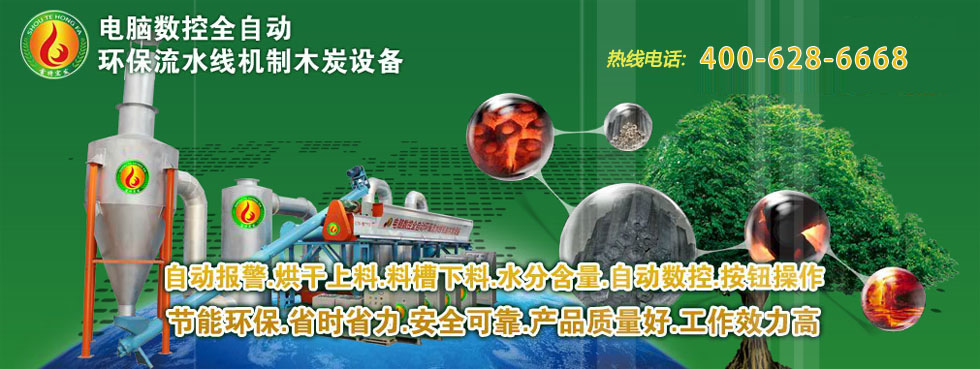
Burning mechanized charcoal is supported by relevant state departments for the above reasons, and more importantly, mechanized charcoal itself does not contain harmful substances such as sulfur. It is smokeless and odorless during combustion, has a high calorific value, and has a long burning time, which is superior to original tree charcoal. At the same time, our charcoal burning equipment uses an environmentally friendly charcoal machine. During the charcoal burning process, the exhaust gas is passed through a condenser to separate the tar among them, so that the exhaust gas meets emission requirements.
In summary, the emergence of mechanized charcoal will be a devastating blow to original tree charcoal. The final result is that the former has infinite vitality, while the latter will gradually withdraw from the historical stage of the charcoal industry.
